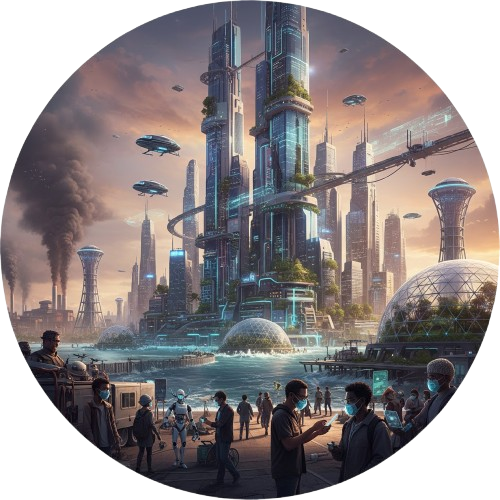

2050 Vision: Where AI’s Ascent Meets Earth’s Reckoning
The year is 2050. We are living in a world of paradox: unprecedented technological comfort clashes with existential environmental threat. Artificial General Intelligence (AGI) is here, driving autonomous cities and personalized healthcare, but the very air we breathe and the water we drink are scarcer than ever. This is the future where the power of the machine is tasked with solving the problems created by man.
A mere quarter-century has transformed our planet into a hyper-connected, yet fractured, realm. While certain regions thrive under the management of hyper-efficient AI-driven utilities, others struggle with the predicted consequences of inaction: devastating water shortages and an alarming rise in air-pollution related deaths, which may surpass 7 million annually if current trends continue.
The Autonomous & Optimized World
By 2050, the concept of a human driver is a historical footnote. Autonomous electric vehicles powered by vast, interconnected smart grids dominate the roads, and drones and underground robotics manage most logistics. This shift, largely driven by AI optimization algorithms, has drastically cut traffic-related fatalities and urban gridlock.
Beyond transportation, AI systems run entire smart cities. They optimize energy distribution, manage waste using advanced recycling nanobots, and even deploy dynamic window coatings to purify the air around buildings. AI is no longer a tool; it is the silent, pervasive operating system of modern human civilization, making split-second decisions to keep the complex urban ecosystem stable.
The Environmental Crisis: A Machine's Burden
Despite technological leaps, the climate crisis has only deepened. Temperatures have pushed past critical thresholds, and extreme weather is commonplace. The human cost is staggering. Air pollution is projected to be the top environmental cause of premature death worldwide, a grim reality that no amount of smart technology can entirely erase without fundamental shifts in industrial energy use. Water scarcity is a daily struggle for over half the global population, forcing rapid, AI-managed deployment of desalination and advanced water recycling plants.
The convergence of AI with green energy has seen a massive transition towards solar, wind, and even ocean thermal energy. The goal isn't just to power civilization, but to prevent the collapse of the biosphere.
The Human-Machine Symbiosis (and Control)
The line between human and machine has blurred. Advanced Brain-Computer Interfaces (BCIs) are no longer science fiction, allowing seamless interaction with the cloud and even digital memory storage. The workforce has fundamentally changed. Routine jobs are gone, replaced by AI and robotics. This has created a vast class of "digital managers," AI trainers, and ethicists, but also necessitated discussions around systems like Universal Basic Income (UBI) as a social safety net. The machines haven't taken over through a violent uprising, but through sheer, irresistible utility and intelligence.
This dependency brings unique concerns: Who governs the AGI that governs the city? Algorithmic bias and data privacy are not philosophical debates but urgent matters of human rights. AI is not just controlling systems; it is influencing human behavior, careers, and even personal relationships through hyper-personalized digital companions and advisors.
Navigating the Future
The world of 2050 is a testament to human ingenuity in the face of self-inflicted wounds. It is a world where machines manage our survival and optimize our lives, allowing a subset of the population to live in an unparalleled era of creativity and leisure, while others grapple with the fallout of past environmental negligence. The future is not set; it is being written every day in the code we deploy and the environmental policies we choose to ignore or embrace.